
If you are wondering what rice cooker 1 litre means, the simple answer is that 1 litre generally describes the volume of the rice cooker’s inner pot, not 1 litre of uncooked rice. A 1-litre cooker cannot usually be filled with 1 litre of dry rice because rice absorbs water, expands during cooking, and needs room to cook without overflowing.
The actual amount of rice a 1-litre rice cooker can safely prepare depends on the manufacturer’s stated rice capacity, the rice-cooker measuring cup, the type of rice, and the cooker design. This guide explains how to interpret the 1-litre measurement, estimate practical cooking capacity, understand serving sizes, and decide whether this size is right for your kitchen.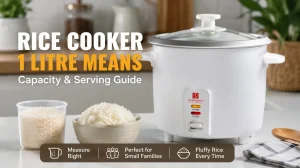
What Does a 1-Litre Rice Cooker Actually Mean?
A 1-litre rice cooker refers primarily to the volume or capacity of its cooking pot. In other words, the “1 litre” label describes how much space the inner cooking vessel can hold, but it should not be interpreted as a recommendation to add 1 litre of uncooked rice.
That distinction is important because dry rice is only one part of the cooking process. Water must also be added, and the rice expands as it absorbs that water. The cooker also needs enough empty space for bubbling, steam, and expansion.
For that reason, a 1-litre rice cooker can have a much smaller maximum dry-rice capacity than its headline litre measurement might suggest. The manufacturer’s stated rice-cup capacity and the maximum-fill markings inside the cooking pot are more useful when deciding how much uncooked rice to prepare.
Important: A 1-litre rice cooker does not mean you can safely cook 1 litre of dry rice. Always follow the manufacturer’s maximum rice capacity and inner-pot markings.
This is also why 2 rice cookers with the same 1-litre label can have different practical cooking capacities. Pot shape, internal markings, heating design, and the manufacturer’s recommended rice quantity can all affect how much rice the appliance is designed to cook.
How Much Rice Can Be Cooked in a 1-Litre Rice Cooker?
There is no single dry-rice quantity that applies to every 1-litre rice cooker. The safest answer is to check the specific model’s maximum rice capacity rather than converting the 1-litre pot size directly into cups of uncooked rice.
Many rice cookers use a dedicated rice-cooker measuring cup that is approximately 180 ml, which is smaller than a standard US measuring cup. The cooker may also have water-level markings that correspond to the number of rice-cooker cups added.
As a practical rule, the maximum amount of uncooked rice should be determined by the cooker manufacturer’s instructions. A model labelled 1 litre may be designed for a particular number of rice-cooker cups, while another model with a similar physical capacity may have a different recommended maximum.
The type of rice matters too. Basmati, jasmine, brown rice, short-grain rice, and other varieties do not all absorb water or expand in exactly the same way. A quantity that works well for one variety may not be appropriate for another.
The safest approach is therefore:
- Check the manufacturer’s maximum dry-rice capacity.
- Use the measuring cup supplied with the rice cooker.
- Follow the water markings or instructions for the type of rice being prepared.
- Leave sufficient room for expansion and bubbling.
- Do not assume that 1 litre of pot capacity equals 1 litre of uncooked rice.
Overfilling a rice cooker can cause more than a messy countertop. Excess rice and water can interfere with even cooking, cause starchy water to bubble over, and contribute to poor results. If you regularly experience overflow, uneven cooking, or other issues, our guide to common rice cooker problems can help identify the likely cause.
What Is a Rice Cooker Cup?
A rice cooker cup is the measuring cup traditionally supplied with many rice cookers. It is commonly around 180 ml, or roughly three-quarters of a standard US cup.
This difference can cause confusion when people compare rice cooker specifications. If a manufacturer says a cooker handles a certain number of “cups,” those cups may refer to the supplied rice-cooker measure rather than a standard kitchen measuring cup.
Using the supplied cup is therefore one of the easiest ways to follow the manufacturer’s intended rice and water measurements. If the cup is missing, check the manufacturer’s documentation before assuming that a regular measuring cup is equivalent.
Why You Should Not Treat 1 Litre as 1 Litre of Dry Rice
Dry rice expands as it absorbs water. The cooking process also produces steam and bubbling, so the inner pot cannot be filled completely with ingredients simply because its physical capacity is 1 litre.
Think of the litre rating as the size of the cooking vessel rather than the amount of dry food you should put inside it. The usable cooking capacity is smaller once you account for rice, water, expansion, and the space required for safe cooking.
This distinction explains why online capacity claims can sometimes look contradictory. One source may discuss total pot volume, another may discuss cooked-rice yield, and another may be referring to the manufacturer’s rice-cup rating. These are different measurements.
How Many People Does a 1-Litre Rice Cooker Serve?
A 1-litre rice cooker is generally more appropriate for smaller cooking needs than for large family-size batches, but the exact number of people it serves depends on portion size and how rice is used in the meal.
A person eating a modest serving of rice alongside vegetables, meat, fish, or another main dish will need less cooked rice than someone using rice as the main part of the meal. Leftovers and meal preparation also change how much capacity you need.
For an individual or couple, a 1-litre cooker can be a practical middle ground when a very small personal cooker is too limiting but a large cooker would take up unnecessary counter or storage space.
For a larger household, the issue is not simply whether the cooker can produce rice. The important question is whether its maximum recommended batch is enough for the number of portions normally served at one time.
If you normally prepare small portions rather than large batches, a compact cooker can make more sense than buying a much larger appliance. You can also compare the needs of smaller households with the options discussed in our guide to rice cookers for small quantities.
Rice Cooker Sizes in Litres: 0.5L to 3L Compared
Rice cookers are available in a wide range of capacities, from compact personal models to much larger appliances intended for families, gatherings, or commercial use. Looking at the size range helps put a 1-litre rice cooker into perspective.
| Rice Cooker Size | General Use | What to Consider |
|---|---|---|
| 0.5 litre | Very small portions and personal use | Limited batch size; useful where compactness matters most |
| 0.6 litre | Small portions and compact kitchens | Check the manufacturer’s rice-cup capacity |
| 1 litre | Individuals, couples, and smaller households | Balance rice capacity, portions, and available space |
| 1.2 litre | Small to medium household cooking | Useful when 1L capacity feels restrictive |
| 1.5 litre | Medium household cooking | Offers more batch capacity but requires more storage space |
| 1.8 litre | Larger household portions | Better suited to bigger batches |
| 2 litre | Large batches and bigger households | Consider how often you actually need the extra capacity |
| 3 litre and above | Large households, gatherings, or specialized use | Usually unnecessary for people cooking small quantities |
These size categories should be treated as general guidance rather than exact serving specifications. A litre measurement alone does not tell you the precise number of rice-cooker cups a particular model can safely handle.
That is especially important when comparing terms such as rice cooker 1.5 litre price, rice cooker price 3 litre, or rice cooker 5 litre price. Before comparing prices, compare the actual cooking capacity and intended use of the models.
What Types of Rice Can You Cook in a 1-Litre Rice Cooker?
A 1-litre rice cooker can prepare many common types of rice, provided the particular appliance supports them and the recommended quantities are followed.
White Rice
White rice is usually the simplest place to start because many standard rice cookers are designed primarily around this type of rice. Follow the water markings or instructions supplied with the cooker instead of applying a universal ratio to every model.
Basmati and Jasmine Rice
Basmati and jasmine rice can also be prepared in a rice cooker, but the preferred water quantity can differ from the settings used for other varieties. The rice packaging and cooker instructions should take priority over a generic internet ratio.
Brown Rice
Brown rice generally has different cooking requirements from white rice. It can require more water and a longer cooking cycle, so the recommended maximum quantity may differ from the amount suitable for white rice.
Using the correct water level is particularly important in a small cooker because there is less room to accommodate mistakes in ingredient volume. If the cooker has a dedicated brown-rice setting, follow the manufacturer’s instructions for that program.
Other Rice and Grains
Some rice cookers can also prepare other grains, but suitability depends on the appliance. Quinoa, oats, barley, and similar foods can behave differently from rice because they absorb water and expand at different rates.
Do not assume that every grain can be cooked using the same quantity or program as white rice. The cooker manual or grain packaging should provide the appropriate method.
What Else Can You Cook in a 1-Litre Rice Cooker?
A compact rice cooker can be useful for more than rice when the appliance is designed to support additional cooking functions. Common possibilities include oatmeal, porridge, quinoa, other grains, steamed vegetables, and some small one-pot meals.
The exact options depend on the cooker. A model with a steaming basket, for example, can offer more flexibility than a basic cooker designed only for rice.
Alternative cooking is also affected by capacity. Even if a cooker can technically prepare another food, the recipe still needs enough room for liquid, expansion, and bubbling. A 1-litre cooker should therefore be treated as a compact cooking appliance rather than a miniature version of a full-size multi-cooker.
If you are interested in using a rice cooker beyond traditional rice preparation, see our guide to other ways to use a rice cooker for more ideas and practical considerations.
Is a 1-Litre Rice Cooker Worth It?
A 1-litre rice cooker can be worth buying if you regularly prepare relatively small quantities of rice and want a compact appliance that handles the cooking process automatically.
The value depends on how closely the capacity matches your normal meals. Buying a cooker that is much larger than necessary can waste storage space, while choosing one that is too small can force you to cook multiple batches.
A 1-litre model can make sense for someone who cooks for themselves, a couple, or a small household. It can also suit kitchens where countertop and storage space are limited.
On the other hand, people who regularly prepare large batches for several people may find a larger cooker more practical. The right size is the one that comfortably handles your usual cooking quantity without requiring frequent extra batches.
Pros of a 1-Litre Rice Cooker
- Compact size: It generally takes less storage and counter space than a larger rice cooker.
- Suitable for smaller meals: The capacity can match households that do not need large batches.
- Simple cooking: A rice cooker can reduce the need to monitor rice continuously on the stovetop.
- Convenient portions: A smaller cooking vessel can make it easier to prepare an amount appropriate for a small household.
- Versatility: Depending on the model, it may handle grains and other small meals as well as rice.
Cons of a 1-Litre Rice Cooker
- Limited batch capacity: It may not be suitable for large families or gatherings.
- Less flexibility for large meal preparation: Cooking multiple batches can become inconvenient.
- Model differences: A 1-litre label does not guarantee the same dry-rice capacity across different brands.
- Potentially limited functions: Some compact models are simpler than larger multifunction rice cookers.
Ultimately, whether a rice cooker is worth buying depends on how often you cook rice, how much you normally prepare, and whether the convenience justifies the space and cost of another kitchen appliance.
What to Look for When Choosing a 1-Litre Rice Cooker
If you are shopping for an electric rice cooker 1 litre, do not choose based on the litre number alone. Several other specifications can have a bigger effect on whether the cooker fits your needs.
Manufacturer-Stated Rice Capacity
Look for the maximum number of rice-cooker cups the manufacturer says the appliance can prepare. This is usually more useful than attempting to calculate dry-rice capacity from the litre measurement.
Rice-Cooker Measuring Cup
Check whether the cooker includes its dedicated measuring cup. Using the intended cup makes it easier to follow the manufacturer’s rice and water markings accurately.
Inner-Pot Markings
Clear markings can simplify the cooking process. They can help you match the amount of rice added with the appropriate water level without relying on a generic conversion.
Inner-Pot Material
Consider the cooking pot material and how easy it is to clean. If stainless steel is important to you, our guide to rice cookers with stainless steel inner pots provides a more focused look at that category.
Keep-Warm Function
A keep-warm function can be convenient when the rice is finished before the rest of the meal. However, rice quality can change when it remains warm for a long time, so the feature should be treated as a convenience rather than a reason to keep rice indefinitely.
Ease of Cleaning
Removable inner pots and accessible lids can make regular cleaning easier. A cooker that is simple to clean is more likely to be convenient for frequent use.
Physical Size
Check the actual dimensions rather than relying only on the 1-litre label. Two cookers with similar capacity can have different footprints because of their shape, controls, lid design, and external housing.
Price and Value
If you are comparing an electric rice cooker 1 litre price or searching for a rice cooker 1 litre price, compare the price against the actual features and capacity you need. A cheaper cooker is not necessarily better value if its usable capacity, controls, or cleaning design do not suit your cooking habits.
How to Avoid Common 1-Litre Rice Cooker Capacity Mistakes
The most common mistake is assuming that the litre rating tells you exactly how much dry rice to add. It does not. The litre figure needs to be considered alongside the manufacturer’s rice-cup capacity and cooking instructions.
Do Not Fill the Pot With 1 Litre of Dry Rice
Dry rice needs water and room to expand. Treating the entire 1-litre volume as available space for dry rice can lead to overflow and poor cooking results.
Do Not Ignore the Maximum Rice Mark
If the cooker has a maximum-fill or rice-level marking, use it. These markings are part of the appliance’s intended cooking system and are more useful than a generic capacity conversion.
Do Not Assume Every 1-Litre Cooker Is Identical
A 1-litre cooker from one manufacturer may have different rice-cup recommendations from another. Always check the specific model instead of applying one internet estimate to every cooker.
Do Not Use One Water Ratio for Every Rice Variety
Different rice varieties have different cooking requirements. Water quantity can also vary according to the rice brand, age, preparation method, and cooker design.
Do Not Ignore Cooking Problems
Persistent burning, overflow, or undercooked rice can indicate a measurement, water-level, ingredient, or appliance issue. If burning is your specific problem, see our guide explaining why rice can burn in a rice cooker.
A rice cooker automatically controls the cooking cycle based on conditions inside the appliance. Understanding how a rice cooker knows when to stop can also help explain why the correct rice-to-water quantity matters.
Frequently Asked Questions About 1-Litre Rice Cooker Capacity
What Does the “Litre” Size in a Rice Cooker Actually Mean?
The litre size generally refers to the volume or capacity of the rice cooker’s inner cooking vessel. It does not mean the cooker is designed to hold the same amount of dry rice. Dry rice needs water and expands during cooking, so the safe rice quantity is determined by the manufacturer’s recommended capacity.
How Many Cups of Rice Does a 1-Litre Rice Cooker Hold?
There is no universal number of dry-rice cups for every 1-litre rice cooker. The manufacturer’s stated rice-cup capacity should be used because different models can have different usable cooking capacities. Also remember that a rice-cooker cup is commonly about 180 ml, rather than a standard US measuring cup.
How Much Rice Can Be Cooked in a 1-Litre Rice Cooker?
The exact amount depends on the specific model and rice variety. Check the manufacturer’s maximum rice-cup capacity, use the supplied measuring cup, and follow the recommended water level rather than assuming that 1 litre of pot volume equals 1 litre of uncooked rice.
How Many People Does a 1-Litre Rice Cooker Serve?
A 1-litre rice cooker is generally better suited to individuals, couples, and smaller households than to large groups. The exact number of servings depends on portion size, the type of meal, and whether you want leftovers.
Is a 1-Litre Rice Cooker Good for 1 or 2 People?
Yes, a 1-litre rice cooker can be a practical choice for 1 or 2 people when the manufacturer’s recommended rice capacity matches the amount you normally eat. A smaller cooker can also save space when large batches are unnecessary.
Is a 1-Litre Rice Cooker Worth Buying?
A 1-litre rice cooker can be worth buying if you regularly prepare small quantities of rice and value convenient, compact cooking. It may not be the best choice for households that frequently need large batches.
What Is the Difference Between a 1-Litre and 1.8-Litre Rice Cooker?
The main difference is capacity. A 1.8-litre cooker generally provides more cooking space than a 1-litre model, making it more suitable for larger batches. However, the exact dry-rice capacity and serving recommendation still depend on the manufacturer.
Can You Cook Other Grains in a 1-Litre Rice Cooker?
Many rice cookers can prepare grains such as quinoa or oats, but the exact suitability depends on the appliance. Follow the manufacturer’s instructions because different grains require different water quantities and cooking times.
Final Thought
The most important thing to understand about rice cooker 1 litre means is that the 1-litre figure describes the cooker’s capacity, not a guaranteed amount of uncooked rice. Rice needs water and room to expand, so the actual dry-rice limit must come from the specific model’s manufacturer instructions.
If you are choosing a 1-litre rice cooker, focus on its stated rice-cup capacity, serving needs, inner-pot markings, cooking functions, cleaning requirements, and physical size. That approach will give you a much more accurate idea of whether the cooker is suitable than simply converting 1 litre into cups of dry rice.
For most people considering a compact rice cooker, the best size is ultimately the one that matches the amount of rice they normally prepare without requiring frequent extra batches or leaving excessive unused capacity.