
Does your kitchen cabinet feel full but still waste valuable space? How to organize kitchen cabinets starts with decluttering, grouping similar items, creating practical kitchen zones, and using storage organizers only where they solve a real problem.
The best system keeps frequently used items within easy reach while moving bulky, heavy, and rarely used items into more suitable storage areas. This guide explains how to organize upper and lower cabinets, deep shelves, corner cabinets, food storage, cookware, dishes, appliances, and small kitchens.
If you are also looking for practical tools that earn their cabinet space, our guide to affordable kitchen gadgets can help you avoid buying items that simply create more clutter.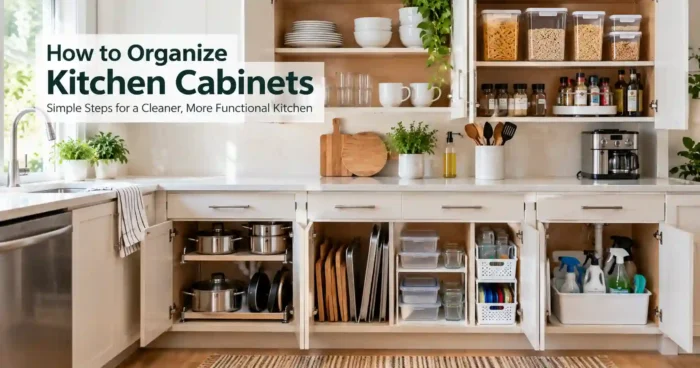
How to Organize Kitchen Cabinets Step by Step
The simplest approach is to empty the cabinets, remove unnecessary items, group what remains, create kitchen zones, and then assign each item a logical home.
- Empty one cabinet or section at a time.
- Declutter before reorganizing.
- Clean the empty storage area.
- Group similar items together.
- Create zones around kitchen activities.
- Place frequently used items within easy reach.
- Store heavy items in lower cabinets.
- Use vertical space where practical.
- Measure shelves before buying organizers.
- Label containers only when labels improve access.
Working in sections prevents the entire kitchen from becoming a temporary mess. Therefore, finish one cabinet before moving to the next.
What Should You Do Before Organizing Kitchen Cabinets?
Decluttering should come before organization because storage products cannot fix an excess of unnecessary items.
Empty the Cabinet Completely
Remove every item from the cabinet you are working on. Seeing the entire shelf makes duplicates, unused items, and wasted space easier to identify.
Separate Items Into Useful Categories
Group similar items before returning anything to storage.
- Plates and bowls
- Glasses and mugs
- Pots and pans
- Baking supplies
- Cooking utensils
- Food storage containers
- Spices and condiments
- Small appliances
- Cleaning supplies
- Serving dishes
Grouping makes the next step easier because each category can receive an appropriate storage location.
Remove Duplicates and Items You Never Use
Keep the tools that match your actual cooking habits. If you own several items that perform the same task, consider keeping the most useful versions.
A practical kitchen should support everyday cooking rather than store every gadget that has ever entered the house.
💡 Pro Tip: Before buying an organizer, identify the exact storage problem it needs to solve. An organizer that does not solve a recurring problem can become another source of clutter.
How Should You Create Kitchen Zones?
Kitchen zones work best when related tools stay close to the area where those tools are normally used.
| Kitchen Zone | Items to Store Nearby | Why It Works |
|---|---|---|
| Cooking zone | Pots, pans, cooking utensils, oils and spices | Reduces movement while cooking |
| Prep zone | Cutting boards, knives, mixing bowls and measuring tools | Keeps preparation tools together |
| Baking zone | Baking pans, measuring tools, flour and baking supplies | Makes baking equipment easier to find |
| Dish zone | Plates, bowls, glasses and mugs | Simplifies serving and unloading |
| Food-storage zone | Containers, dry foods and pantry items | Keeps food categories organized |
| Cleaning zone | Sponges, cleaning products and related supplies | Keeps cleaning equipment separate from food |
For example, cookware used beside the range should remain close to the cooking area. Prep tools should stay near the main food-preparation surface.
This approach also makes restocking easier because every category has an obvious home.
How Should Upper Kitchen Cabinets Be Organized?
Upper cabinets work well for lightweight items that you use regularly but do not need at the countertop.
Place everyday plates, bowls, glasses, mugs, and frequently used pantry items where they are comfortable to reach.
Keep Everyday Dishes Accessible
Stack similarly sized plates and bowls together. Avoid creating stacks that are too tall to remove safely.
A shelf riser can create another level when enough vertical clearance exists. However, measure the cabinet first instead of assuming an insert will fit.
Use Upper Storage for Lighter Items
Upper cabinets can hold lightweight serving dishes, glassware, mugs, and less frequently used items.
Heavy cookware and bulky appliances are usually better suited to lower storage.
What Should Go in Lower Kitchen Cabinets?
Lower cabinets are generally better for heavy cookware, larger appliances, pots, pans, and other bulky kitchen equipment.
Heavy cast-iron cookware and stand mixers can be difficult to lift from high shelves. Lower storage reduces that handling problem and keeps heavy objects closer to the floor.
For cookware inspiration, you can also explore our best everyday cookware set guide when deciding which pieces deserve permanent cabinet space.
Store Pots and Pans by Frequency of Use
Keep your most-used cookware closest to the cooking zone. Nest compatible pots and pans when stacking does not damage their surfaces.
Flat lids and baking sheets can often stand vertically with an appropriate divider. Vertical storage makes individual pieces easier to remove.
Keep Heavy Cookware Low
Heavy items should generally stay in lower cabinets for easier handling. This arrangement also keeps upper shelves available for lighter equipment.
If a cast-iron skillet needs regular maintenance, our guide on how to clean a cast iron skillet provides a useful companion resource.
How Do You Organize Deep Kitchen Cabinets?
Deep cabinets become easier to use when storage improves visibility and prevents small items from disappearing behind larger ones.
- Use pull-out organizers for difficult-to-reach shelves.
- Use turntables for small bottles and containers.
- Group similar products in bins.
- Place frequently used items toward the front.
- Move rarely used items toward the back.
- Keep heavy objects low and stable.
A deep shelf should not become a storage area where forgotten items accumulate. If an item repeatedly disappears behind other products, change the storage method.
How Can You Organize a Corner Kitchen Cabinet?
Corner cabinets need storage that improves access to the rear portion of the cabinet.
A lazy Susan can make small containers easier to rotate into view. Pull-out systems can also work well when the cabinet structure supports them.
Before installing anything, measure the cabinet opening, interior width, depth, height, and available door clearance.
How Should You Organize Food in Kitchen Cabinets?
Dry foods should stay in suitable cool, dry storage and away from household cleaning products and chemicals.
The FDA advises keeping nonperishable food away from household cleaning products and chemicals. FDA food-storage guidance provides additional information on safe storage practices.
Group Food by Type
Separate food into practical groups such as grains, canned foods, snacks, baking ingredients, spices, and condiments.
Grouping similar products reduces searching time and makes inventory easier.
Keep Older Products Visible
Move older suitable products toward the front when organizing shelf-stable food. This encourages earlier use and reduces forgotten items.
However, do not treat every printed date as a food-safety deadline. The FDA notes that a “use by” date can indicate quality rather than safety, with specific exceptions such as infant formula.
Use Food Storage Containers Carefully
Airtight containers can help organize opened dry goods and protect contents from moisture and household pests.
Choose containers that fit the cabinet height and shelf depth. Containers that are too tall can waste vertical space.
If meal preparation creates many containers, our guide to best food storage containers for meal prep can help with choosing a practical storage system.
How Should Spices Be Organized?
Spices are easiest to manage when similar containers stay together and frequently used bottles remain visible.
- Group spices in one dedicated area.
- Use a tiered rack when shelf height allows.
- Use a shallow bin for loose spice containers.
- Keep frequently used seasonings near the cooking zone.
- Remove duplicates and stale products.
Avoid placing tall bottles in front of short ones because the front row can hide everything behind it.
How Do You Organize Kitchen Utensils?
Cooking utensils should stay together and remain close enough to the cooking zone for convenient access.
Separate long tools from smaller utensils when the drawer or cabinet becomes difficult to search.
A dedicated utensil set can also make categorization easier. See our best kitchen utensil set Amazon guide for options worth considering.
Use Drawer Dividers for Small Tools
Drawer dividers work well for measuring spoons, peelers, small spatulas, and similar tools.
Keep the most frequently used tools toward the front of the drawer. Rarely used specialty tools can occupy less accessible positions.
Where Should Kitchen Knives Be Stored?
Kitchen knives should have a dedicated storage location that protects the blades and reduces accidental contact.
A drawer insert, knife block, or suitable wall-mounted system can work depending on the kitchen layout.
Do not place loose sharp knives in a crowded drawer where blades can contact hands or other utensils.
For selecting everyday cooking knives, see our guide to best kitchen knives for home cooks.
⚠️ Safety Tip: Keep sharp tools in dedicated storage rather than loose inside crowded drawers. The storage system should make the blade easy to identify and retrieve safely.
How Should Cutting Boards Be Stored?
Cutting boards are easier to access when they stand vertically instead of forming a heavy horizontal stack.
A divider can separate cutting boards from baking sheets and trays. Keep boards close to the food-preparation zone when possible.
For food-safety guidance, the FDA recommends keeping raw foods separate from other foods and using a dedicated cutting board or plate for raw foods.
You can also read our guide to the best cutting board for raw meat when choosing a dedicated preparation surface.
How Do You Organize Baking Supplies?
Baking supplies work best when measuring tools, pans, ingredients, and decorating equipment stay in clearly defined groups.
| Category | Suggested Storage | Useful Organizer |
|---|---|---|
| Baking pans | Lower cabinet | Vertical divider |
| Measuring tools | Drawer or prep cabinet | Small divider |
| Dry ingredients | Cool, dry cabinet | Airtight containers |
| Decorating tools | Dedicated bin | Small storage box |
If baking is part of your normal routine, keep the equipment together rather than spreading individual tools throughout the kitchen.
A kitchen scale can also deserve a dedicated location when baking depends on weight-based measurements. Our best kitchen scale for baking guide covers that category.
How Should Small Kitchen Appliances Be Stored?
Small appliances should occupy cabinet space according to how often you use them and how difficult they are to move.
| Appliance | Best Storage Approach | Reason |
|---|---|---|
| Blender | Near the prep area | Easy access for frequent use |
| Food processor | Lower cabinet | Bulky and often heavy |
| Air fryer | Accessible lower storage or countertop | Frequent use and substantial size |
| Rice cooker | Lower cabinet or appliance area | Bulky shape and cord storage |
Do not keep a large appliance in prime cabinet space if you rarely use it. Instead, move occasional appliances to less accessible storage.
For small kitchens, our guide to the best air fryer for small kitchen can help when appliance size matters.
Likewise, a dedicated food processor for home use can be easier to manage when its bowl, lid, blade, and accessories stay together.
How Do You Organize Under the Kitchen Sink?
The area under the sink works best for cleaning supplies and plumbing-friendly storage rather than food.
Use a removable bin or caddy for cleaning products. Keep frequently used supplies toward the front.
Check containers regularly for leaks. Keep household chemicals away from food, dishes, and food-contact equipment.
The FDA specifically advises against storing nonperishable foods near household cleaning products and chemicals.
How Can You Organize a Small Kitchen With Limited Cabinet Space?
Small kitchens benefit most from vertical storage, strict decluttering, and careful assignment of prime cabinet space.
- Remove duplicate tools.
- Store rarely used items higher or farther back.
- Use shelf risers where clearance allows.
- Store flat items vertically.
- Use cabinet-door storage where appropriate.
- Keep bulky appliances together.
- Use stackable containers for suitable dry goods.
- Move nonessential items out of the kitchen.
Small kitchens need fewer storage decisions, not more storage products. Every organizer should earn its space.
How Do You Organize Kitchen Cabinets Without Buying Organizers?
You can improve cabinet organization without buying anything by decluttering, grouping items, changing shelf positions, and rearranging existing storage.
Start by removing unused items. Next, place frequently used equipment at the front and move occasional items farther away.
Reuse sturdy containers already in the kitchen for loose accessories when the containers fit safely and remain easy to clean.
What Kitchen Cabinet Organizers Are Actually Useful?
The best organizer depends on the specific storage problem, so no single insert works for every cabinet.
| Organizer | Best Use | Main Benefit |
|---|---|---|
| Lazy Susan | Corner cabinets and bottles | Improves visibility |
| Shelf riser | Short items on tall shelves | Uses vertical space |
| Pull-out organizer | Deep lower cabinets | Brings stored items forward |
| Drawer divider | Utensils and small tools | Separates categories |
| Vertical divider | Cutting boards and baking sheets | Keeps flat items upright |
| Stackable bin | Pantry-style cabinet storage | Groups similar items |
| Cabinet-door organizer | Small lightweight supplies | Uses otherwise unused space |
What Should You Measure Before Buying Cabinet Organizers?
Measure the cabinet opening and usable interior space before buying an organizer.
| Measurement | Why It Matters |
|---|---|
| Interior width | Determines whether the organizer fits side to side |
| Interior depth | Prevents an insert from extending too far |
| Interior height | Determines shelf and riser compatibility |
| Door opening | Ensures the organizer can be accessed |
| Shelf clearance | Prevents tall containers from hitting the shelf above |
| Weight capacity | Helps match the organizer to cookware or food loads |
Measure the actual cabinet rather than relying only on the cabinet’s advertised size.
How Do You Decide What Goes in Each Cabinet?
Assign each cabinet according to frequency, weight, size, safety, and proximity to the activity where the items are used.
| Item Type | Preferred Location | Organization Principle |
|---|---|---|
| Everyday plates | Easy-to-reach cabinet | High frequency |
| Glasses | Accessible upper storage | High frequency |
| Heavy pots | Lower cabinet | Weight |
| Spices | Near cooking zone | Task proximity |
| Baking pans | Lower or baking zone | Size and frequency |
| Rare serving pieces | Higher or less accessible storage | Low frequency |
| Cleaning products | Dedicated cleaning zone | Safety separation |
The goal is not to follow one universal cabinet map. Instead, build a layout around the way your kitchen is actually used.
What Are the Biggest Kitchen Cabinet Organization Mistakes?
The most common mistakes include storing too many items, ignoring cabinet dimensions, hiding frequently used tools, and buying organizers before measuring.
- Keeping duplicates: Extra items consume valuable storage.
- Ignoring vertical space: Tall shelves can contain substantial unused space.
- Overloading shelves: Heavy loads can make access difficult and may exceed an organizer’s capacity.
- Mixing unrelated categories: Mixed storage makes items harder to find.
- Putting heavy objects overhead: Lower storage is usually easier for heavy cookware.
- Buying organizers without measuring: An insert can fail to fit or block the cabinet door.
- Storing chemicals near food: Cleaning products should remain separate from food.
- Creating excessive categories: Overly complicated systems are harder to maintain.
How Can You Keep Kitchen Cabinets Organized Long Term?
A simple maintenance routine prevents cabinets from returning to their previous state.
- Return every item to its assigned zone.
- Remove new duplicates when they appear.
- Check food storage regularly.
- Wipe spills promptly.
- Reassess cabinets when cooking habits change.
- Move rarely used equipment out of prime storage.
Organization works best when putting an item away requires little thought. Therefore, keep the system simple enough to maintain every day.
How We Choose the Best Kitchen Organization Solutions
Good kitchen organization should improve access, use available space efficiently, and match the way the kitchen is actually used.
| Criterion | What We Look For |
|---|---|
| Accessibility | Items remain easy to see and retrieve |
| Space efficiency | Unused vertical and horizontal space is used sensibly |
| Frequency | Everyday items receive convenient locations |
| Safety | Heavy and sharp items receive suitable storage |
| Compatibility | Organizers match cabinet dimensions and clearance |
| Maintenance | The system remains easy to maintain |
| Value | Storage products solve a genuine recurring problem |
We favor organization systems that reduce daily friction rather than systems that simply make cabinets look attractive.
What Makes a Good Kitchen Cabinet Organization System?
A good system gives every major category a logical home while keeping frequently used items easy to reach.
- Logical zones: Similar tasks and tools stay together.
- Easy access: Everyday items remain convenient to retrieve.
- Clear visibility: Stored items do not disappear behind unnecessary layers.
- Safe storage: Heavy and sharp equipment gets suitable placement.
- Efficient use of space: Vertical and deep storage gets practical solutions.
- Simple maintenance: The system remains easy to follow.
Frequently Asked Questions About Kitchen Cabinet Organization
How do I organize my kitchen cabinets?
Start by emptying one section, removing unnecessary items, grouping similar products, and assigning each group a practical zone.
Then place frequently used items within easy reach and use organizers only when they solve a specific storage problem.
What is the best way to organize kitchen cabinets?
The best method combines decluttering, kitchen zones, frequency-based placement, and suitable storage solutions.
There is no single cabinet layout that works for every kitchen because cabinet sizes and cooking routines differ.
How do you organize kitchen cabinets to maximize space?
Use vertical space, stack compatible items, store flat objects vertically, and improve access to deep shelves.
However, maximizing space should not mean filling every available gap. Easy access remains more important than maximum density.
How do you organize kitchen cabinets in a small kitchen?
Small kitchens benefit from strict decluttering, vertical storage, multi-purpose organizers, and careful use of prime cabinet space.
Move rarely used equipment away from the most accessible cabinets.
How do you organize deep kitchen cabinets?
Use pull-outs, turntables, bins, or other systems that make rear items easier to see and retrieve.
Keep frequently used items toward the front and reserve rear positions for occasional items.
How do you organize lower kitchen cabinets?
Use lower cabinets for heavy cookware, bulky appliances, pots, pans, and other large items that are easier to lift from a lower position.
Organize cookware by type and frequency so everyday pieces remain accessible.
How do you organize upper kitchen cabinets?
Use upper cabinets for lightweight dishes, glasses, mugs, pantry items, and other products that are comfortable to reach.
Keep heavy equipment in lower storage whenever practical.
How do you organize pots and pans in kitchen cabinets?
Nest compatible pots and pans and store lids or flat cookware vertically when the cabinet allows it.
Keep frequently used cookware near the cooking zone for easier meal preparation.
How do you organize plates and bowls in kitchen cabinets?
Stack similarly sized plates and bowls together while keeping everyday pieces at a comfortable height.
A shelf riser can help separate short stacks when enough clearance exists.
How do you organize spices in kitchen cabinets?
Group spices together and use a tiered rack or shallow bin when those solutions improve visibility.
Keep frequently used seasonings near the cooking area.
How do you organize a corner kitchen cabinet?
Use a lazy Susan, pull-out system, or another suitable organizer that improves access to the rear of the cabinet.
Measure the cabinet before choosing an insert.
How do you organize a kitchen cabinet under the sink?
Use the space for cleaning supplies and plumbing-related storage while keeping food away from household chemicals.
Removable bins and caddies can make leaks easier to detect and supplies easier to remove.
How do you organize kitchen cabinets without a pantry?
Use dedicated cabinet zones for dry foods, group products by type, and use stackable containers when they improve visibility.
Keep food away from household chemicals and unsuitable heat sources.
What should go in upper kitchen cabinets?
Upper cabinets can hold lightweight dishes, glasses, mugs, frequently used dry goods, and less frequently used serving items.
Choose locations based on reachability and kitchen layout.
What should go in lower kitchen cabinets?
Lower cabinets are suitable for heavy cookware, pots, pans, bulky appliances, and other large kitchen equipment.
Lower storage can make heavy items easier to handle.
What kitchen items should not be stored in cabinets?
Items that require refrigeration should not remain in ordinary cabinets, while household chemicals should stay away from food.
Always follow the storage directions on the product label.
How do you make more storage space in kitchen cabinets?
Declutter first, then use vertical storage, stacking, dividers, and suitable inserts to improve the usable arrangement.
Better organization often creates more usable space without increasing the cabinet’s physical capacity.
How often should you reorganize kitchen cabinets?
Reorganize whenever the current system stops matching your cooking habits or becomes difficult to maintain.
A quick review every few months can also help remove duplicates and forgotten items.
Final Thoughts
The best kitchen cabinet organization system is practical, easy to maintain, and built around the way the kitchen is used every day.
Start with decluttering instead of buying storage products. Then create kitchen zones, prioritize accessibility, store heavy items low, and use organizers only where they improve the system.
- Best kitchen utensil set Amazon: useful for organizing cooking tools and utensil storage.
- Best food storage containers for meal prep: useful for structured dry-food and container storage.
- Best everyday cookware set: useful when organizing pots and pans around the cooking zone.
- Best kitchen knives for home cooks: useful when planning dedicated knife storage.
- Best cutting board for raw meat: useful for separating and organizing food-preparation equipment.
- Best air fryer for small kitchen: useful when appliance size affects cabinet and countertop space.
- Best food processor for home use: useful when planning storage for bulky food-preparation appliances.
- Best kitchen scale for baking: useful when creating a dedicated baking zone.
- How to clean a cast iron skillet: useful for maintaining frequently used cookware.