
What sounds like a simple kitchen appliance took years of experimentation to perfect. Yoshitada Minami is widely credited with developing the first practical automatic electric rice cooker in Japan in 1955.
However, the history is more complicated than naming one inventor. Earlier companies had already developed electric rice-cooking devices, but those machines did not fully automate the process.
The 1955 Toshiba ER-4 changed that. The cooker could detect when cooking had finished and switch itself off, reducing the need for constant supervision.
This article explains who invented the rice cooker, what came before the 1955 breakthrough, how the Toshiba ER-4 worked, and how rice cookers evolved into today’s appliances.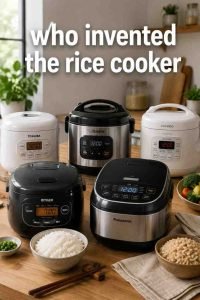
Who invented the rice cooker?
Yoshitada Minami is commonly credited with developing the first practical automatic electric rice cooker. Toshiba introduced the resulting ER-4 in Japan in 1955.
Minami worked with Toshiba’s appliance division during the development of the automatic cooker. His company, Koshinsha, became involved in solving the technical challenges behind automatic rice cooking.
However, Minami did not invent every form of electric rice cooker. Earlier electrical cooking devices had already appeared, so the exact answer depends on how the term “rice cooker” is defined.
For that reason, the most accurate description is that Minami was a central figure in the development of the practical automatic electric rice cooker.
Was the first electric rice cooker the same as the automatic model?
No. Early electric rice cookers could heat rice, but they generally still required human supervision.
Several manufacturers experimented with electric rice cooking before Toshiba’s 1955 breakthrough. The main challenge was not producing heat. Instead, engineers needed a reliable way to know when the cooking cycle had finished.
Traditional rice cooking also required careful control of heat and timing. Therefore, an electric heating element alone did not remove the need for supervision.
The automatic cooker solved that problem by using changes in temperature as a signal for the end of cooking.
What happened before the 1955 rice cooker?
Before automatic electric cooking became practical, households commonly prepared rice using cooking methods that required close attention.
The cook had to manage the heat throughout the process. Too much heat could burn the rice, while too little heat could leave the grains undercooked.
Electric rice-cooking experiments attempted to make the process easier. However, early machines still had limitations.
The eventual breakthrough came when engineers combined electric heating with automatic temperature-based switching.
Who developed the automatic electric rice cooker?
The automatic cooker emerged from work involving Yoshitada Minami, Koshinsha, and Toshiba’s appliance division.
Toshiba wanted an appliance that could prepare rice without requiring someone to monitor the cooking process. The development team therefore had to solve both engineering and cooking problems.
The work required experiments with water levels, rice quantities, temperatures, and cooking times. Those tests helped establish conditions that could produce reliable results.
What role did Yoshitada Minami play?
Yoshitada Minami provided important technical development work for the automatic electric rice cooker project.
Electrical engineering alone could not solve the problem. The team also needed to understand how rice absorbed water and how temperature changed during cooking.
That combination of electrical design and cooking experiments helped make automatic operation practical.
Did Fumiko Minami help develop the rice cooker?
Fumiko Minami played an important role in testing cooking conditions during the development process.
Historical accounts describe her testing different water-to-rice ratios, temperatures, and cooking times. Her experiments helped identify conditions that produced consistent cooked rice.
Her contribution highlights an important part of the invention story. The appliance needed to understand the cooking process, not simply generate heat.
Therefore, describing the invention as the work of one person alone misses part of the historical development.
💡 Historical note: The automatic rice cooker was a development effort involving engineers, appliance companies, and extensive cooking experiments. Yoshitada Minami remains the key inventor associated with the practical automatic design.
When was the first automatic rice cooker invented?
The key milestone came in 1955, when Toshiba introduced the ER-4 automatic electric rice cooker in Japan.
Toshiba’s historical material identifies the ER-4 as its first domestic automatic electric rice cooker.
The model represented a major change in household cooking. Users no longer needed to watch the rice continuously or manually determine when the heating cycle should stop.
IEEE Spectrum’s historical account places the ER-4’s introduction on December 10, 1955.
What was the Toshiba ER-4?
The Toshiba ER-4 was the landmark automatic electric rice cooker introduced in Japan in 1955.
The appliance combined an electric heating system with an automatic switching mechanism. That combination allowed the cooker to respond to changes during the cooking process.
Instead of relying entirely on a preset cooking time, the mechanism used temperature behavior to determine when cooking had reached its endpoint.
The result was a practical household appliance that reduced the attention required to prepare rice.
How did the first automatic rice cooker work?
The early automatic design used temperature changes to determine when cooking had finished.
Water plays an important role in this process. While water remains in the cooking environment, the temperature stays close to the boiling point.
After the available water evaporates, the temperature begins to rise. The automatic mechanism can detect that change and interrupt the electrical circuit.
This basic principle allowed the appliance to recognize the end of the cooking stage without constant human supervision.
For a modern explanation of this same principle, see our guide to how a rice cooker knows when to stop.
How did the bimetallic switch control cooking?
A bimetallic switch responded to the temperature increase and helped disconnect the heating circuit.
A bimetallic component contains two metals that respond differently to heat. As the temperature changes, the component bends.
That movement can operate an electrical switch. In the early automatic design, the switch provided a simple mechanical way to stop heating.
The approach was clever because it connected a physical change in the cooking environment with an electrical action.
Why was temperature control important?
Temperature control gave the appliance a practical signal for recognizing the end of the cooking stage.
A fixed timer could not always account for different amounts of rice and water. Cooking conditions can change when the quantity changes.
Temperature offered a more useful indicator. Once the available water had evaporated, the rising temperature signaled that the cooking process had changed.
This principle remains central to understanding how automatic rice cookers operate.
Why was the rice cooker invented?
The rice cooker was developed to reduce the time, attention, and household work involved in preparing rice.
Rice was an important part of everyday meals in Japan. Traditional preparation required someone to monitor the heat and timing.
An automatic appliance could handle much of that work instead. The user could prepare the rice, start the cooker, and attend to other tasks.
Therefore, the invention was not simply about replacing a stove with electricity. The larger goal was cooking automation.
Was the rice cooker invented in Japan?
Japan played the central role in developing and commercializing the practical automatic electric rice cooker.
Toshiba introduced the ER-4 in Japan in 1955. The company identifies that model as its first domestic automatic electric rice cooker.
However, earlier electric rice-cooking experiments mean that “invented in Japan” needs some qualification.
The most accurate statement is that Japan became the birthplace of the practical automatic electric rice cooker that established the modern category.
What came before Toshiba’s automatic model?
Earlier manufacturers experimented with electric rice cooking before Toshiba created a practical automatic household model.
Mitsubishi Electric, Matsushita, and Sony are among the companies associated with early electric rice-cooking experiments.
Those developments matter because they show that the technology evolved through several stages. The 1955 Toshiba cooker did not appear without earlier experimentation.
The crucial difference was automatic control. Toshiba’s model connected the heating system to a mechanism that could recognize the end of cooking.
Who developed the early electric rice cooker?
Several manufacturers contributed to the early development of electric rice cookers, so there is no single inventor for the entire category.
Historical accounts describe early experiments by companies including Mitsubishi Electric, Matsushita, and Sony.
These efforts helped establish the basic concept of electrically heated rice cooking. Later work focused on making the process automatic and reliable.
This distinction also explains why different sources can give different answers to the question of who invented the appliance.
Why is 1955 the most important date in rice cooker history?
1955 marks the transition from electric rice cooking to practical automatic rice cooking for Japanese households.
The Toshiba ER-4 combined electric heating with automatic switching. That combination removed much of the supervision required by traditional methods.
The innovation therefore changed the role of the appliance. The cooker did more than provide heat; it controlled part of the cooking process.
That principle became the foundation for later automatic and electronic models.
How did rice cookers evolve after 1955?
Rice cookers evolved from simple automatic heating appliances into electronic cooking systems with sensors and specialized programs.
Later models improved temperature control and added features such as keep-warm functions.
Manufacturers eventually introduced microcomputer-controlled cookers. More advanced designs could adjust cooking behavior based on sensor readings.
Some modern models also use fuzzy logic, induction heating, or pressure cooking.
The basic purpose, however, remains familiar: prepare rice with less manual attention and more consistent results.
Modern inner-pot designs have also changed considerably. For example, our guide to rice cookers with stainless steel inner pots explores one of the construction choices found in today’s appliances.
How did rice cookers evolve from basic machines?
The category progressed from manual cooking to electric heating, automatic switching, and eventually computerized control.
- Traditional cooking: The cook manually controlled heat and cooking time.
- Early electric cookers: Heating elements reduced some manual work but still needed supervision.
- Automatic electric cookers: Temperature-based switching allowed the appliance to stop heating automatically.
- Electronic cookers: Sensors and programmed controls improved cooking consistency.
- Advanced models: Fuzzy logic, induction heating, and pressure cooking added greater control.
Each stage addressed a limitation from the previous generation. As a result, rice cooking became increasingly convenient.
What is the rice cooker invention timeline?
The invention story follows a progression from traditional cooking to electric heating and then automatic control.
| Period | Milestone | Why It Matters |
|---|---|---|
| Before electric cookers | Traditional rice cooking | Required careful heat and timing control. |
| Early 20th century | Electric rice-cooking experiments | Introduced electrical heating to rice preparation. |
| 1955 | Toshiba ER-4 | Marked the major automatic electric rice cooker breakthrough. |
| Later decades | Improved automatic cookers | Added better temperature control and keep-warm functions. |
| Modern era | Electronic and advanced cookers | Added sensors, programmed cycles, and specialized cooking modes. |
What makes the automatic rice cooker different?
Automatic control is the feature that separates the practical modern rice cooker from a simple electric cooking pot.
A basic electric pot can provide heat. An automatic rice cooker can also determine when the main cooking stage has finished.
The distinction matters because automation reduces the need for continuous monitoring.
Modern rice cookers build on that same idea with more advanced sensors and electronic controls.
What can we learn from the rice cooker invention?
The rice cooker shows how successful household inventions often combine engineering with a detailed understanding of everyday tasks.
The developers needed knowledge of electricity, heat transfer, temperature, switching mechanisms, rice, and water absorption.
Fumiko Minami’s cooking experiments also show why practical testing mattered. A mechanism could work electrically but still produce poor rice.
The final solution had to satisfy both requirements. It needed to automate cooking while still producing useful results.
Frequently Asked Questions About Rice Cooker History
Who invented the rice cooker?
Yoshitada Minami is commonly credited with developing the first practical automatic electric rice cooker. Toshiba introduced the ER-4 in Japan in 1955, following development work involving Minami and others.
When was the first rice cooker invented?
The key milestone for the automatic electric rice cooker was 1955. Toshiba introduced the ER-4 that year as a domestic automatic rice cooker in Japan.
Who invented the electric rice cooker?
No single person can be credited with inventing every type of electric rice cooker. Several companies experimented with electric rice cooking before Toshiba’s automatic breakthrough.
Where was the rice cooker invented?
Japan played a central role in the development of the practical automatic electric rice cooker. Toshiba introduced the ER-4 there in 1955.
How did the first rice cooker work?
Early automatic designs used temperature changes to determine when cooking had reached its endpoint. A switching mechanism could interrupt the electrical circuit when the temperature rose after the available water evaporated.
Why was the rice cooker invented?
The appliance was developed to reduce the work and supervision required to prepare rice. Automatic control allowed households to cook rice without continuously managing the heat.
Was the first electric rice cooker automatic?
No, early electric rice cookers generally required some human supervision. Automatic switching became the important breakthrough that distinguished later models.
Did Fumiko Minami help invent the rice cooker?
Fumiko Minami contributed important cooking experiments during the development of the automatic cooker. Historical accounts describe her testing rice, water, temperature, and cooking-time combinations.
What was the Toshiba ER-4?
The ER-4 was Toshiba’s first domestic automatic electric rice cooker, introduced in 1955. The model became a major milestone in automatic rice cooking.
How have rice cookers changed over time?
Rice cookers progressed from simple automatic heating appliances to sophisticated electronic cooking systems. Modern models can use sensors, programmed cycles, fuzzy logic, induction heating, and pressure cooking.
Final Thoughts
The history of the rice cooker is really the story of turning a demanding cooking task into an automated process.
- Yoshitada Minami: The central inventor associated with the practical automatic electric rice cooker.
- Fumiko Minami: An important contributor to the cooking experiments behind the development.
- Toshiba: The company that introduced the ER-4 in 1955.
- ER-4: The landmark automatic electric rice cooker from 1955.
- Early manufacturers: Mitsubishi Electric, Matsushita, and Sony contributed to earlier electric rice-cooking development.
The most accurate short answer is therefore clear: Yoshitada Minami is widely associated with developing the first practical automatic electric rice cooker, introduced by Toshiba as the ER-4 in 1955.
However, earlier electric rice-cooking devices deserve recognition. The distinction between an electric rice cooker and an automatic electric rice cooker explains why 1955 is such an important date.
For readers interested in the technology behind modern models, our related guide explains how automatic shut-off works. You can also explore common rice cooker problems to understand some of the issues that can affect modern appliances.
Sources: